Not RPO or Even a Stunt Double
This could be how the story started. But Best Man was really brother Jim.
Sopranos Blackout: “This Magic Moment” from DGA Quarterly
Having now watched The Sopranos two or three times, with one eye, one ear and half a brain, I find myself unable to accept the notion that Tony was killed at that final blackout ending in Holsten’s ice cream parlor. There was an authoritative-seeming article on the subject in a 2015 issue of the Directors Guild of America Quarterly, here archived at the Wayback Machine. I copypaste text and pictures here without fanciness, mainly for my own perusal.
This Magic Moment
Eight years after it aired, the finale of The Sopranos continues to be hotly debated. David Chase explains how he created the excruciating tension of the last scene. What he won’t say is what happened at the end.
By James Greenberg

After orchestrating the murder of a rival gang boss and dodging a bullet yet again, Tony (James Gandolfini) is breathing, if not easier, with at least a sense of relief as he meets his wife Carmela (Edie Falco) and kids (Jamie-Lynn Sigler and Robert Iler) at Holsten’s for “the best onion rings in the state” and flips through the jukebox. It’s almost a Norman Rockwell scene with a group of Cub Scouts, young lovers, football hero murals, and locals enjoying the warm and homey atmosphere. Chase says time itself is the raw material of the scene as the suspense builds with pinpoint editing while Journey’s “Don’t Stop Believin'” propels the action to its climax—a heart-stopping cut to black.
Chase was after the dreamy, chilling feeling he admired at the end of Stanley Kubrick’s 2001: A Space Odyssey in which time expands and contracts as life and death merge into one. And there, as in the concluding instant of The Sopranos, who knows what really happens. “When it’s over,” Chase offers, “I think you’re probably always blindsided by it. That’s all I can say.”

It was my decision to direct the episode such that whenever Tony arrives someplace, he would see himself. He would get to the place and he would look and see where he was going. He had a conversation with his sister that went like this. And then he later had a conversation with Junior that went like this. I had him walk into his own POV every time. So the order of the shots would be Tony close-up, Tony POV, hold on the POV, and then Tony walks into the POV. And I shortened the POV every time. So that by the time he got to Holsten’s, he wasn’t even walking toward it anymore. He came in, he saw himself sitting at the table, and the next thing you knew he was at the table.

Alik Sakharov, the DP, and I saw the location and talked about it a lot. I had a vision in my head when I wrote it, but when you move into a place you have to figure out how to shoot in that location. We wanted to be in the middle of the room obviously, so we could be on either side of the booth. We didn’t want to be shooting against a blank wall on one side of the booth; we wanted it to be in the middle to give it depth all around. But there was a radiator unit in the only place where we would really have the room, so we had to build a booth over that radiator unit. It was very difficult. And we did not have much room to dolly or track around. So a lot of what we did in this scene came about after going to Holsten’s. The vision has to coalesce with the real physical location.

Tony’s flipping through the jukebox; it’s almost like the soundtrack of his life, because he sees various songs. No matter what song we picked, I wanted it to be a song that would have been from Tony’s high school years, or his youth. That’s what he would have played. When I wrote it, there were three songs in contention for this last song, and ‘Don’t Stop Believin” was the one that seemed to work the best. I think it’s a really good rock ‘n’ roll song. The music is very important to me in terms of the timing of the scene, the rhythm of the scene. The song dictates part of the pace. And having certain lyrics of the song, and certain instrumental flourishes happen in certain places, dictates what the cuts will be. I directed the scene to fit the song. The singing gets more and more strident and more invested as the song goes along. Musically it starts to build and build into something as it’s just about to release. And when you look at the scene, you get that feeling.

I love the timing of the lyric when Carmela enters: ‘Just a small town girl livin’ in a lonely world, she took the midnight train goin’ anywhere.’ Then it talks about Tony: ‘Just a city boy,’ and we had to dim down the music so you didn’t hear the line, ‘born and raised in South Detroit.’ The music cuts out a little bit there, and they’re speaking over it. ‘He took the midnight train goin’ anywhere.’ And that to me was [everything]. I felt that those two characters had taken the midnight train a long time ago. That is their life. It means that these people are looking for something inevitable. Something they couldn’t find. I mean, they didn’t become missionaries in Africa or go to college together or do anything like that. They took the midnight train going anywhere. And the midnight train, you know, is the dark train.

Tony hears the bell when the door opens and he’s repeatedly looking up when he hears it throughout the scene. That rhythm is very important to the scene. The bell harkens back to the first episode [of the second part] of the final season called ‘Sopranos Home Movies,’ when Tony is out on a dock on this lake, and every once in a while a boat’s bell dings and brings him out of himself and back to the present. So here’s the bell again, and sure enough, he looks up, and then he gets distracted, and there’s the bell again. In my mind, it’s like a meditation bell. Not to be thinking about the past, not to be thinking about the future, only about now. It’s like the song ‘This Magic Moment.’ I used that at the end of ‘Sopranos Home Movies,’ and it’s one of the songs he sees on the jukebox in this episode.

My thinking about wanting to introduce A.J. and the guy together was that both the audience and Tony would not focus on the guy so much, they would focus on A.J. Tony would focus on his son, rather than the man who might be there to do him harm. A lot of the audience I gathered doesn’t like A.J.; they think he’s a useless, spoiled fool. But there’s also something about him that is earnest. He’s got his father’s kind of questioning and kind of little boy innocence. When I see Tony reach across and grab his arm [when he arrives], it makes me feel really good. Not only that, I’ll tell you who else is reaching across the table, that’s Jim Gandolfini reaching across to Robert Iler in the last scene they’re going to do together. I never talked about it with them, but I know for a fact.

Cutting to Meadow parking was my way of building up the tension and building up the suspense, but more than that I wanted to demonstrate the lyrics of the song, which is streetlights, people walking up and down the boulevard, because that’s what the song is saying. ‘Strangers waiting.’ I wanted you to remember that is out there. That there are streetlights and people out there and strangers moving up and down. It’s the stream of life, but not only that, it’s the stream of life at night. There’s that picture called History Is Made at Night [from 1937]. I love that title. And that kind of echoes in my head all the time.

I just wanted the guy to look over. I didn’t want him to look particularly menacing. And he glances off Tony so quickly. We worked on that quite a bit so he wasn’t staring at him. The guy was like looking around the place in general. Tony doesn’t acknowledge that he sees him. Tony leads a very dangerous, suspicious life and he’s always on guard. But he’s in this old-fashioned American sweet shop with those round stools and the counter and the football hero pictures and Cub Scouts. Everything that should make him feel at ease, and yet there is a slight ill at ease feeling which we bring to it because we know who he is and what he’s done. And he can never be sure that any enemy is completely gone. He always has to have eyes behind his head.

The tension is quite high now, but if you think about it, for no real reason. Who’s in the place? A guy in a jacket, Cub Scouts, a young couple, a trucker in a hat, a couple of black guys in there to buy some candy. There’s no real reason for the tension to ratchet up. But it does. And that’s what I love, how you make that. Of course, a tremendous amount of that happens in the editing room. You’ve got the pieces and you’ve got the intention, but who do you come back to and who you don’t, what’s the expression on their face. I think that’s what montage and editing do best. And music. They play with time. You’re going, ‘come on, hurry up, no, slow down, no, hurry up, no, no, no, slow down.’ That plays with your heartbeat, because that’s the real clock.

We tracked a bit in this shot. We had to move to get the bathroom sign. I can’t say it was tricky, but it was time consuming because of the tight space. Yes, the scene in The Godfather [when Michael Corleone kills Sollozzo and McCluskey] occurred to me; it’s an iconic scene. I would say that Tony checked the guy out at some level. I mean any middle-aged male that would get that close to him, I’m sure he would do some summary surveillance of. It may be very quick; his instincts are very sharp. He doesn’t feel threatened by him but I’m sure he clocks that that guy’s in the bathroom, and that that guy should come out. It’s more like ‘I want to see that guy come out.’ This is all on a subconscious level, I’m sure. We all do this, every moment of our lives.

I tried to build the tension and suspense as much as possible. That’s why I could go back out to Meadow and her car-parking. I could use all that stuff to affect the pace. I think almost every director is thinking about the pacing. That’s what directing is. I did want to create the idea that you would wonder if something was going to happen in there. Meadow is filled with nothing but very, very deep emotions about parking her car. But possibly a minute later, her head will be filled with emotions she could never even imagine. We all take this stuff so seriously—losing our keys, parking our car, a winter cold, a summer cold, an allergy—whatever it is. And this stuff fills our mind from second to second, moment to moment. And the big moment is always out there waiting.

This is the last shot of the family, or the three of them anyway. Framing is extremely important. I think it makes you feel so much below the level of verbiage and words. What they’re talking about is how good those onion rings are. For me, food is always central to a feeling of family and to a feeling of security and happiness. A.J. had remembered a moment at the end of the final show of the first season when they were all sitting down, eating in Vesuvio’s Italian restaurant and Tony said, ‘Just remember … value the good times,’ the moments, there really aren’t that many of them. And this is one of the very good times. And yet there’s something wrong with it because Meadow is not there. So the family isn’t really together. I think on some subliminal level that raises the tension. We know the family should be together and they’re not.

I said to Gandolfini, the bell rings and you look up. That last shot of Tony ends on ‘don’t stop,’ it’s mid-song. I’m not going to go into [if that’s Tony’s POV]. I thought the possibility would go through a lot of people’s minds or maybe everybody’s mind that he was killed. He might have gotten shot three years ago in that situation. But he didn’t. Whether this is the end here, or not, it’s going to come at some point for the rest of us. Hopefully we’re not going to get shot by some rival gang mob or anything like that. I’m not saying that [happened]. But obviously he stood more of a chance of getting shot by a rival gang mob than you or I do because he put himself in that situation. All I know is the end is coming for all of us.

I thought the ending would be somewhat jarring, sure. But not to the extent it was, and not a subject of such discussion. I really had no idea about that. I never considered the black a shot. I just thought what we see is black. The ceiling I was going for at that point, the biggest feeling I was going for, honestly, was don’t stop believing. It was very simple and much more on the nose than people think. That’s what I wanted people to believe. That life ends and death comes, but don’t stop believing. There are attachments we make in life, even though it’s all going to come to an end, that are worth so much, and we’re so lucky to have been able to experience them. Life is short. Either it ends here for Tony or some other time. But in spite of that, it’s really worth it. So don’t stop believing.
The Angry Years: The Rise and Fall of the Angry Young Men
[Counter-Currents edition, slightly redacted, is here.]
 When Colin Wilson sat down in 2006 to write his own history of the “Angry Young Men,” it was mainly a matter of settling accounts. There had been at least two other similarly named books on the subject, and they were informative and entertaining[1]. But they mostly retold familiar tales that had run in the London press, from 1956 onward, usually with Wilson himself as a central figure. Here we have a final, synoptic gospel where the popular old prophet himself is doing the telling, and there aren’t too many people left to contradict him.
The book was published in 2007. As Colin died in 2013, he did us a signal service in getting these confusing and often pointless stories sorted out and down on paper while he had the time and energy.
I’m talking about well-worn Angry Young Man tales that got recycled in the press, mainly in 1956-58, ones that usually turn out to more silly than substantial. For example, there’s that Royal Court pub brawl. It seems that in early 1958 Kenneth Tynan and friends loudly walked out on a new, and rather bad, play. It was a play by Wilson’s friend Stuart Holroyd and was having its first (and maybe only) night at the Royal Court Theatre[2]. There was a fracas afterwards. Not only did it make the London morning papers, the story found its way to New York, even turning up in Time magazine with the headline, “Sloane Square Stomp.”
It was hardly a brawl, in Wilson’s telling. Holroyd, Wilson and friends simply repaired to a pub for some chatty drinks after the play. Someone told them that Kenneth Tynan, Christopher Logue[3] and other miscreant theatre-leavers were at a drinking hole nearby. So Wilson et al. traipsed off to that nearby pub, where Holroyd’s wife grabbed Logue by the throat and knocked him off his chair. Whereupon the pub’s landlord told them to leave.
They went to a friend’s nearby flat, where Bill Hopkins telephoned his brother and other newspapermen around town. Colin Wilson heard him in the next room. “Is that the Daily Mail? Have you heard about this brawl outside the Royal Court ? … Well there was Stuart Holroyd, Colin Wilson, Bill Hopkins…”[4]
Not much of a story, is it? But newsworthy, if you make it so. I first heard these recollections from Bill Hopkins and Colin Wilson thirty-odd years ago. It was like being a little kid overhearing turn-of-the-century scandals about Aunt Petunia. It all made very little sense to me.
But the Royal Court brawl story reminds me of something Bill Hopkins told me much later. He was walking through Covent Garden with a girlfriend a year or so later when they passed a familiar face: that selfsame Christopher Logue. Reflexively Bill said hello. Logue said nothing and passed on. The girlfriend hissed in Bill’s ear: “He hates you!”[5] Well, Bill was oblivious. The idea of someone holding a grudge because of a facetious media-event was beyond him.
Rather like the tales of how Colin Wilson often slept rough in Hampstead Heath, and spent his days writing and researching at the British Museum’s Reading Room. His Hampstead Heath days were pretty much behind him by this time, but Life magazine quickly assigned a crack photographer to follow Wilson around with a Rolleiflex, catching him on his bicycle, posing with a mug of tea in his bedsit, and reading a book on the Heath while half snuggled-up in his “waterproof sleeping bag” (which he now had little need of as he was now a successful writer living in cramped accommodations in Notting Hill). Colin was happy to comply, but somewhat puzzled by later accusations that he was a fraud because he no longer slept rough in Hampstead Heath.
Another thrice-told tale is the one about Kingsley Amis receiving a bottle of whisky from Colin but refusing to drink it because (he said) he was scared of Wilson and feared it might be poisoned:
I was too afraid to drink a bottle of whisky Colin Wilson once gave me, and there it stayed on my shelf till an intrepid psychiatrist pal guzzled it with no ill effects, or none but the usual.[6]
According to Wilson, the whisky was a gift from him back in 1957 when he and then-girlfriend, future wife Joy Stewart were on the run from the press, and Joy’s parents (who had literally tried to horsewhip the brilliant young author of The Outsider). While they eventually ended up in Cornwall, where they lived for many years, they stopped for a bit at Amis’s house in Swansea, where Amis was then teaching. Wilson assures us the whisky could not have been poisoned, as obviously the seal had not been broken.
Kingsley Amis, and his lifelong friend Philip Larkin, figure hugely in The Angry Years, which came out when both had been safely dead for a decade or more. (Amis died in 1995, Larkin in 1985.) Amis is a neurotic who doesn’t drive and is afraid to fly. He gets his inspiration for his novels’ sex escapades from Larkin’s masturbatory fantasies and real-life adventures.
I see here a good argument for living to a ripe old age, or at least to one where your potential enemies are dead and you won’t be contradicted.
Wilson sets us up at the beginning with a synopsis-outline “Analytical Table of Contents” of what the chapters are going to be about. This front-of-book apparatus lets you home in on what you’re looking for, as you slide back and forth in his narrative. No doubt this began as the author’s own aide-memoire (as in, what do we write about next?). And then decided, once his typescript was almost done, that it would be quite as readable and useful for the general audience, and thus included it at the front of the book. The format a great guide for any biography or popular history, and I’d like to see more of it.
Anyway, here is a smidgen of that outline. From an early chapter that mainly describes, or disses, Kenneth Tynan:
2. He That Plays the King
Tynan at Oxford. ‘Have a care for that box, my man – it is freighted with golden shirts.’ His taste for masturbation and female posteriors. He begins to write theatre reviews. His pornography collection. ‘Just a thong at twilight.’ He marries Elaine Dundy. She objects to being flogged. His career as a director stalls…
Tynan, of course, was long passed from the scene by this point (died in 1980, age 53, of emphysema) and couldn’t object to this.
Wilson has a lot of fun with Tynan’s famous concluding puff on the John Osborne play:
I doubt if I could love anyone who did not wish to see Look Back in Anger. It is the best young play of its decade.
Ridiculous, of course. Kenneth Tynan did not love much of anything besides showing off, and smacking young ladies’ bare bottoms with canes. Tynan’s career, at Oxford and after, mostly consisted of sneering and lambasting whatever he saw on stage. Now Tynan was praising this new playwright to the skies, not because he loved Osborne’s talent but because it gave him an opportunity to get back at all the actors and theater managers he had offended, people who had got him sacked from the newspapers he was reviewing for.
At least that’s Colin Wilson’s reading, and it seems plausible enough.
Notes
[1] I recommend both of the other book I know, which are both available at the Internet Archive. I link them here. The first was Kenneth Allsop’s The Angry Decade: a Survey of the Cultural Revolt of the Nineteen-Fifties (1958), a book that Colin Wilson liked, though he remarked that it should really be called The Angry Eighteen Months . . . since Allsop got it out in a hurry! In such a hurry that Allsop greatly revised it six years later, when there was a lot more news to tell. Allsop was a silver-haired, silky voiced, very handsome television presenter on the BBC in the 1960s. He made such an impression on the young Tom Wolfe that when Wolfe was journeying in England in the mid-60s, Allsop briefly appeared in one of Wolfe’s Sunday-supplement articles in a London weekend paper. It seems some snooty Cambridge lads were watching Allsop on the telly and one remarked that poor Allsop would “never get the Midlands out of his voice.” Allsop was actually from Yorkshire. The article appears as “The Mid-Atlantic Man” in Wolfe’s The Pump House Gang, 1968. Besides being a television talking-head, Allsop was also a readable and prolific journalist and literary critic who published over 15 books before dying in his early 50s from a barbiturate overdose.
Humphrey Carpenter’s The Angry Young Men: A Literary Comedy of the 1950s (2002) gave Colin Wilson less pleasure, as a lot of it is exploitation pop history. For example, Carpenter refers to Bill Hopkins and Stuart Holroyd as Wilson’s “satellites,” and smacks his lips over the fall of Wilson’s shooting star after the dismal reception of his sequel to The Outsider, Religion and the Rebel. Carpenter takes gratuitous slams over some lines in Wilson’s Introduction, writing, “He concluded this opening chapter with what seemed to be a sinister promise that he would soon emerge as a new Oswald Mosley: ‘I am not necessarily a writer. The moment writing ceases to be a convenient discipline for subduing my stupidity and laziness, I shall give it up and turn to some more practical form.’” A bizarre put-down suggesting that Carpenter regarded Colin Wilson as a nostalgic joke, never mind that he was very much alive and well. Humphrey Carpenter had also written biographies of J. R. R. Tolkien and Dennis Potter, who by the time Carpenter got around to them were safely dead. “Totally out of sympathy with the writers he was discussing,” is Wilson’s summation in The Angry Years:
For Carpenter, the really significant movement of the mid-century was the satire trend that began with Beyond the Fringe and the television series That Was the Week that Was. By comparison…the ‘Angry Young Men’ were beneath serious consideration.
[2] The Royal Court Theatre often comes up in Angry Young Man stories, as it was the venue for Look Back and Anger and many other plays of that era, and many since. But is impossible to imagine if you don’t know it, as it is in an oddball location. Instead of being in the West End, by other legitimate theaters in London, it is at Sloane Square between Chelsea and Belgravia. For that reason, or whatever, it has always attracted offbeat, non-touristy productions. It appears in the Woody Allen movie, Match Point, because aspiring actress Scarlett Johansson is supposed to be auditioning there.
[3] Christopher Logue (1926-2011) was a poet, playwright, contributor to Private Eye, and sometime actor (according to Wikipedia he played a spaghetti-eating fanatic in Terry Gilliam’s Jabberwocky).
[4] Colin Wilson, The Angry Years.
[5] Postcard from Bill Hopkins, c. May 1993.
[6] Humphrey Carpenter, The Angry Young Men.
Orwell and the Angries: A Listicle
I’ve been trying to figure out how George Orwell fits into that 1950s literary phenomenon, or cult, called the Angry Young Men. The Angries, as a movement, were partly an invention of the popular press of 1956-58. Some writers who are included among them, notably Kingsley Amis, rejected the label and got counted in only because they were new young writers with an irksome attitude. Others, e.g., Colin Wilson, treated the whole concept whimsically or dismissively but used it as a publicity tool.
The “Angry Young Men” expression first arose in 1956 when a 26-year-old playwright named John Osborne staged his controversial (but successful) play called Look Back in Anger, and 24-year-old Colin Wilson published his controversial (and also successful) book of essays on philosophy and literary criticism, called The Outsider. Osborne and Wilson had little in common otherwise, but they both made good copy, with their attractive looks and tumultuous personal lives. So they got grouped together with other newsworthy young writers, mostly male, and got called Outsiders or the Angry Young Men. Of course, the latter handle won out. Others counted among the Angries include Wilson’s friends Bill Hopkins and Stuart Holroyd, filmmaker Lindsay Anderson, and novelists John Wain, John Braine, Alan Sillitoe, and sometimes Doris Lessing and Iris Murdoch.[1]
The connection between Orwell and the Angries seems intuitively obvious today, at least to me. They have many points in common, so that some of the Angries—in public persona if not in writing—might be considered School of Orwell. However, these Fifties writer seldom commented on Orwell at the time. He had only been dead a few years, after all. The big Orwell industry, with its fat biographies and criticism, didn’t get underway until the 1980s, mainly due to copyright restrictions imposed by Orwell’s widow Sonia.
So here is my list of parallels:
The scruffy-autodidact affectation. This was sort of a fetish for Orwell when he devoted himself to writing in his 20s. To get source material, he pretended to be down and out in Paris (where his mother’s sister lived in bohemian comfort) and London (where he put on rags so he could review the various “spikes” or doss houses where hobos spent the night). He went hop-picking amongst tramps in Kent and hung out with nighttime derelicts in Trafalgar Square (all background for A Clergyman’s Daughter). Otherwise he dressed in worn tweed coats and flannel bags, and smoked rollups of cheap shag tobacco. Even after he published a few novels, this look continued to be the Orwell brand. The grey, oppressive atmosphere of Keep the Aspidistra Flying (out of cigarettes; out of razorblades; landlady is watching you) was transferred almost intact to the setting of Nineteen Eighty-Four. Moving on to the post-Orwell 1950s, we get Colin Wilson sleeping rough in Hampstead Heath while spending his days in the Reading Room of the British Museum. He shares scruffy houses in Notting Hill with Bill Hopkins and Stuart Holroyd, and even after he’s famous for The Outsider, he and his second wife Joy occupy a cramped bedsit, which they show off to visiting news photographers: a single table-cum-desk, cluttered with books, typewriter, papers, teacups, remnants of old meals. Joy’s parents barge in one evening and horsewhip Colin with an umbrella and a…horsewhip. They have found his notebooks among Joy’s things and imagine that Colin’s notes for a perverse novel are his own sexual confessions. (The newspapers just lapped that story up!)
Perhaps the most dismal and Orwellian passage in Tom Maschler’s Declaration anthology is Lindsay Anderson’s opening to his own contribution, “Get Out and Push!”:
Let’s face it, coming back to Britain is always something of an ordeal. And you don’t have to be a snob to feel it. It isn’t just the food, the sauce bottles on the café tables, and the chips with everything.[2]
Orwellian, except Orwell himself much approved of having the sauce bottles on the dinner table. Not only that, I seem to recall he reprimanded his first wife for removing the outer paper wrapping to Worcestershire sauce; it should remain on the bottle, as in a working-class café.
No Uni Education. This is not true of all the Angries. Kingsley Amis, John Wain and Lindsay Anderson were all at Oxford, Amis became a fellow at Cambridge and visiting fellow at Princeton. But quite true of John Osborne and maybe his alter-ego Jimmy Porter in Look Back in Anger; and of Colin Wilson, Bill Hopkins, Sillitoe, Braine and others. Not going to university had been less of a class marker for George Orwell because he’d been through Eton, though he nevertheless felt barred from the quality-lit circles because he’d gone into the Indian Police instead of Oxbridge. But for the Angries without much formal education, it tended to cause them to be portrayed as novelty acts, rosebushes growing upon a dungheap. In The Angry Decade[3], one of at least three good books about the Angries (Colin Wilson himself wrote another) Kenneth Allsop makes the opening argument that for all the noise they made at the time, the Angries left little movement or imitators behind them. They were a fad that came and went. This was very different from the Satire Boom crowd of the early 1960s (Beyond the Fringe, Private Eye, etc.), where the principals went on and on for decades, in entertainment and publishing, and spawned endless imitators. But the Satire Boom people were Oxbridge, many of them from public schools before that. The Angries, for the most part, were not.

Victor Gollancz. Gollancz published Orwell for a while in the 1930s, but they fell out over Orwell’s anti-Stalinist Homage to Catalonia. In the 1950s Gollancz published Colin Wilson’s and Kingsley Amis’s early books. Gollancz was an Oxford graduate, of Polish Jewish background, a sometime teacher and editor who prospered in the book trade in the 1930s, first with his own publishing imprint, then with something called the Left Book Club. For a subscription fee, Left Book Club members agreed to buy, at deep discount, Gollancz’s book-of-the-month. Orwell’s The Road to Wigan Pier was an LBC offering in 1937. Victor Gollancz books were readily recognizable by their yellow covers with stark, unadorned type. After the War, Gollancz turned away from Leftist politics. He’d lost out, after all, on Orwell’s Animal Farm and Nineteen Eighty-Four. Gollancz continued as a successful mainstream publisher, with titles by Daphne du Maurier, J. G Ballard and John Updike, as well as Wilson and Amis.
The Fascist Taint. From the 1940s onward, it was a commonplace among those of the far-Left that George Orwell was some kind of “Fascist Trotskyite,” and was not to be trusted. (I don’t have a citation for you; I heard people of a certain background say things like this when I was young, because they themselves had heard it while growing up in the Forties and Fifties.) This was Stalinist cant, basically, but it had the effect of normalizing such expressions when thrown at dissident or liberal writers in the 1950s and 60s. Only in recent years, with the resurgence of Antifa groups, has it become common to see “Fascist” used unironically as a slur. But in the 1950s, when Colin Wilson and friends Bill Hopkins and Stuart Holroyd were accused of having Fascist sympathies, it was easy to dismiss it all as a joke. This was so, even though Wilson and company were known to be friendly to Sir Oswald Mosley and his revived Union Movement—a public association George Orwell most certainly would have avoided!
Notes
[1] A “definitive” list of the Angries is sometimes considered to be the list of contributors to Declaration, a 1957 anthology of essay manifestoes by: Lindsay Anderson, Kenneth Tynan, Stuart Holroyd, John Osborne, Doris Lessing, Colin Wilson, Bill Hopkins, and John Wain. Seeking at least one female contributor, the publisher sought out Iris Murdoch, who declined but suggested Doris Lessing.
[2] From Lindsay Anderson, “Get Out and Push!,” in Declaration, edited by Tom Maschler. London: MacGibbon & Kee, 1957.
[3] Kenneth Allsop, The Angry Decade, revised edition. (London: Peter Owen, Ltd.) 1964.
A Pleasant Afternoon with Harriet and Bill Simpson
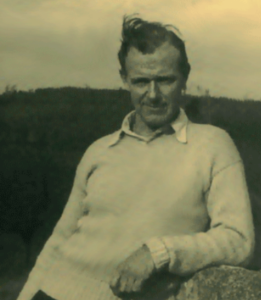 Back in 1986 my friend Fritz Berg [1] was suddenly inspired to drive 100 miles north into Upstate New York (Fritz lived in Fort Lee, NJ, across the George Washington Bridge) and drop in on William Gayley Simpson.
This was more than a joyride and I suppose it wasn’t all that sudden; Fritz had some kind of agenda in the works. Bill was getting old (about 94 now) and there was talk about him and his wife moving north to Cooperstown, NY, mainly for health reasons. Cooperstown (Pop. 1820), founded by James Fenimore Cooper’s father, had everything; or at least it had doctors, as well as arts festivals and, of course, baseball. It was a major metropolis compared with where the Simpsons were living now, which was basically the middle of nowhere, in a rambling old house in the woods.
The place didn’t even have a name, so far as I knew. A year ago I finally researched it and found that there was a tiny hamlet down the road calling itself Prattsville (Pop. 700). But actually Prattsville is a “town,” i.e.,a subdivision of Greene County; not a village but rather what in other states might be called a township. Thus, a town with 700 people over 20 square miles, an area about the size of Manhattan. And that’s where Harriet and Bill Simpson lived, the edge of a forest in the northern Catskills. It’s also where Bill ended up being buried in 1990, after dying in hospital in Cooperstown.
Digging a little deeper, I learned that Bill had been given this house, with attached farm and woodlands, way back in 1932. Yes, he was given it, the way you might give away your spare copy of Which Way, Western Man? (about which, more later). Bill had once been a Presbyterian minister, but he became disenchanted with Christianity after reading Nietzsche, so he defrocked himself and became instead a professional lecturer and Seeker After Truth. He did the whole Razor’s Edge trip, traveling to India and the Far East, meeting gurus and mystics, ever searching after the meaning of existence. Having never had any interest in gurus and mystics, I found these accounts more otherworldly than intriguing. [2]
As another churchman wrote of Bill in 1934:
He longed to live close to the earth, away from the madness of cities, and to grow his
own food with his own hands. And it was at this time that a friend, knowing of his need,
gave him a farm near Prattsville, New York, high up in the Catskill Mountains. [3]
I love this story. Anybody got a spare farm you don’t need? A newspaper clipping from 1935 says that Bill “bought” the house and acreage from one Gordon E. Becker, but this may reflect a simple formality of deed transfer.
Regardless, here we were 54 years later, and Bill had to figure out what to do about the property. His wife was much younger, but she wasn’t about to remain in that house by herself, an elderly widow alone in the woods, high up in the Catskills. So now Bill was thinking along eleemosynary lines—he ought to give the house and land to a charity, or a foundation, or something like that. Bill had had at least one child with his earlier marriages (I count at least two wives before Harriet, whom he married in 1965) but the child or children never seemed to be in the picture, and there was no talk about leaving the Prattsville farm to the whelps.
All of which brings us back to the subject of Fritz Berg. Fritz was floating some scheme about turning Bill’s house into a writer’s retreat. The idea is that we’d set up some not-for-profit, choose some candidates willing to live at our little mountain Yaddo, and Bill would make the property over to the foundation’s board. We had a mutual friend who’d lived for a couple of years on a private buffalo preserve in the middle of Nebraska, where he ostensibly was working on a big book that would prove definitively that the Holocaust Was a Hoax. But long-form writing eluded this fellow during the period when he was out where the buffalo roamed. So instead he ended up writing sprightly little articles for The Spotlight and a church newspaper.
Fritz figured Prattsville might be a better alternative to the buffalo preserve, with the extra advantage that it wasn’t way the hell out in Nebraska. And if you needed some fellowship and entertainment—well, the fleshpots of Fort Lee and Manhattan were just a couple of hours away! Alas, however; the buffalo guy took a job with one of the Carto enterprises and moved out to California. But there were other writers…maybe we could find some.
And so one Saturday Fritz and I and a couple of curiosity-seeking friends made the long drive up to this place in the woods. Fritz brought along a ham steak he’d had in the refrigerator, because the Simpsons were vegetarians, mayhaps even vegans, and it was suggested that we bring along some normal-people food. So that was the ham steak. Bill’s wife Harriet said she had no idea how to cook it, so I grilled it in a skillet, and it ended up with the consistency of shoe leather. Bill and Harriet’s luncheon food was good, as I recall, but the ham experience has blotted out all recollection of anything else we ate.
“That ham really was pretty terrible, wasn’t it?” said Fritz later on. I let him think maybe it had lain in his refrigerator too long, rather than me overcooking it in the skillet. “Fritz is tight as a drum,” said Matt Balic, one of our fellow travelers.
Harriet—Mrs. Simpson—was seventy years old, but looked much younger. The sort of person who’d proudly proclaim her age because she knew she looked attractive and fit, and laughed at the Grim Reaper. She seemed a healthy, athletic 52, maybe, with freckles and strawberry-blond hair. I vaguely recall that the Simpsons had one room of the house given over to exercise equipment. (Willis and Elisabeth Carto did, too, in their hilltop Escondido home which, once you drove up there, seemed almost as isolated as Prattsville.) Harriet was one of the most upbeat and cheerful people I ever met, the sort of person who enters a room and it’s like you’ve opened the Venetian blinds and let the sunlight in. Bill looked good for his years, too, though of course the 24-year age gap was noticeable, and Bill’s personality was ineradicably dour. Regardless, their Life-Extension Institute program, or whatever it was, was wearing very well on them.
Harriet and Bill also had a dog, a very noble rough collie bitch, probably a pedigreed descendant of Albert Payson Terhune’s Sunnybank Kennels broods. (Would they have known each other? Terhune’s father had been a Presbyterian pastor in Newark, New Jersey in the 1800s, Bill came from Elizabeth, and pastored a Presbyterian church in Morris County. The Terhunes and Simpsons crossed paths somewhere.) The collie needed to be taken for a walk, and I offered. We went down the road and then around the house a couple of times, with Matt Balic following and badgering me to let the dog off the leash. I could not do that. I had strict instructions from Harriet. Finally Matt grabbed the leash from me and tossed it on the ground. The collie bounded off into the woods, while Matt laughed. I managed to retrieve the dog, but Harriet had seen it all through the kitchen window. I was in a sulk against Matt for the rest of the day.
* * *
Bill and I were pen-pals for a month or two afterwards. Our epistolary colloquies went sort of like:
“Well Bill, HOW CAN WE SAVE THE WESTERN WORLD?”
“Margot! Don’t you know we’ve already LOST?! We LOST a long time ago!”
Conversation had been a bit cheerier over lunch. I didn’t say much, letting Fritz lead the way, prompting Bill to talk about the fallacies of Christian altruism, and how it has ruined our race and our country. He was curious about ethnic backgrounds. Since Fritz was German, he asked if the rest of us were. Not quite; we were Irish and Scots and Croat. Bill changed his own ethnicity description through the years. On his 1917 draft card he listed his race as “Anglo Saxon.” By 1934 (per the foreword to Toward the Rising Sun) he was claiming his ancestry was “pure Gaelic.” Maybe something about the English had got his nose out of joint in the meantime, so he changed affinities, like Spike Milligan.
Bill had taken the wrong path at times, but I often felt he drew the wrong conclusions about it. He had once been enamored of the example of St. Francis of Assisi, particularly the bit about how Francis was a rich kid who gave all his goods to the poor. Bill did something like that too, when young. And then there was the time he graduated from Union Theological Seminary and was offered a plum billet as pastor of a wealthy church in Philadelphia. He refused that and chose instead a poor church in an industrial town in New Jersey. [4] Christianity for Bill eventually became the Light that Failed, a snare and a delusion. He started out by thinking Christianity was all about self-abnegation and sacrifice and hardship, and this led him very easily to Friedrich Nietzsche’s belief that it was a destructive “slave mentality.” Nietzsche grew up in a parsonage, and this may be one reason why ex-parson Bill took a liking to him.
Bill tells about that St. Francis obsession in both Toward the Rising Sun (1934) and Which Way, Western Man? (1978, revised ed. 2003). And it appears in newspaper stories about him in the 1930s. I found it baffling. If you really want to be like St. Francis, why not join the Franciscans? Or perhaps become an ornithologist?
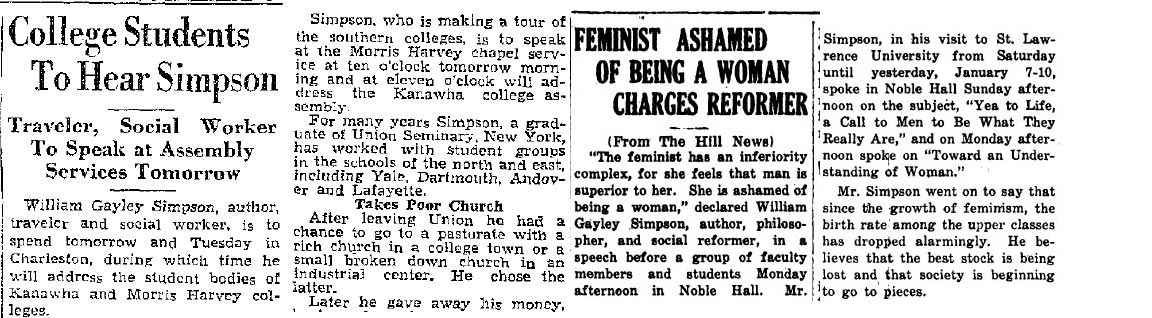
1930s college lecture tours, in Charleston WVa and Canton NY
Those two books, the bijou 1934 one and the vast 1978 tome, are not only separated by 44 years, they show two subtly different mentalities: the first is about a theologian, or ex-theologian, seeking the meaning of life and preparing sermons or philosophical lectures. He warns us of dangers, or “sirens” that tempt us as we struggle along our path. One of them is basically a platitude out of Shakespeare’s Polonius: “To thine own self be true”—or don’t destroy your own well-being with futile struggle and sacrifice to hold onto a dysfunctional marriage or unworkable belief system (I think Bill knew both dilemmas). But then we come to a bigger concern:
The next siren against which I feel it important to warn you is — Christian morality. Perhaps I had better call it Christian pity.
This he illustrates with a tale of a lighthouse keeper to whom is entrusted a quantity of oil to keep the light burning. But then some local villagers are perishing of famine and beg him to share the oil, which they evidently intend to consume. (Really? Whale oil? Kerosene?) Anyway he gives them oil and the light goes out, and ships at sea, caught in a storm perish on the rocks.
The bigger, later volume avoids these clumsy circumlocutions. Having struggled through most of his personal journey, and enumerated his many mistakes, Simpson is now ready to say what he means. If Christianity has been a force for evil it’s because it’s been a Trojan Horse of false science and inverted ethics. The same of course can of be said atheistic materialism; evil uses whatever tool is convenient.
Race and Eugenics are now on the table and must be openly discussed. Like Pierre Teilhard de Chardin, Bill Simpson is revolted by the UNESCO preachments on race in the 1950s. To recap, UNESCO originally published a “Declaration of World’s Scientists” claiming that human races did not exist. (FALLACIES OF RACISM EXPOSED, Unesco Courier, 1950.)
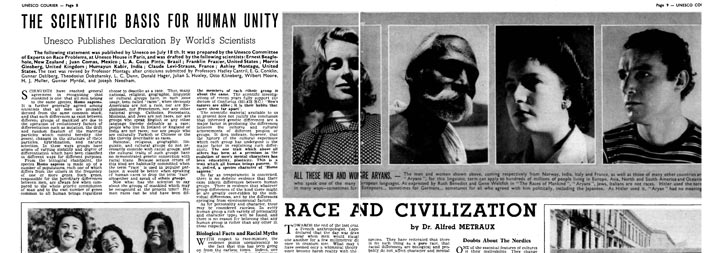
Writes Simpson,
[This manifesto] was so flimsily thrown together and so promptly repudiated by outstanding biologists, physical anthropologists, and geneticists from all over the world, that it had to be replaced the very next year with a modified, but still unsatisfactory, substitute statement, whose departures from the previous version plainly served to acknowledge and “emphasize not only the undocumented nature of the original assertions, but their actual fallacy.”
Despite that retraction, UNESCO continued to propagate the original statement, even augmenting it as the years went by. Not surprisingly, UNESCO often leaned on the expertise of race-denier extraordinaire Ashley Montagu (alias Israel Ehrenberg), author of Man’s Most Dangerous Myth: The Fallacy of Race (1942).
UNESCO followed up with its pronouncement of 1964 that “no biological justification exists” for opposing racial intermarriage, [and] the general public has been led to think that racial differences, if they exist, are of no consequence and can be ignored, and more and more often we see a fair young maiden walking down Main Street hand in hand with a jet black Negro.
Thus the inspirational lecturer who did college speaking tours in the 1930s, and was fawned over in the press for his quest for social justice and human betterment, now revealed himself as a full-on race-realist, a white nationalist and believer in eugenics, with a doorstop of a book published by Dr. William Pierce’s National Vanguard.
Revilo Oliver wrote an incisive and respectful analysis of Which Way, Western Man? (reprinted at Counter-Currents here), using the review mainly as a pretext to expand upon the preposterousness of Christianity and religious delusion in general, the mendacity of Jews, and his own curious theories about rivaries among early Christian sects. I’ve always felt, however, that Prof. Oliver must have thought of Bill Simpson’s career much as he once described Whittaker Chambers’s. Painful and inspirational, but the story of a man who clearly was cursed with poor judgment. And if he was so terribly wrong about his enthusiasms when young, his insights are also likely to be awry when he is old.
* * *
Along with disposing of his Prattsville house and property, wanted to cull some of the thousands of books he’d collected over the year. They included several boxes of the 1978 edition of Which Way, Western Man? Fritz suggested he pay Bill for a half-dozen copies, which he could then sell or give to friends. Bill took various other books into his care, gratis. He had a great collection of 1920s and 30s volumes he’d inherited from old Bundists.
The others in our traveling party got in on the act, and I myself bought about four copies of Bill’s book.
So I ended up with five copies of Which Way, Western Man? on my wireframe bookshelves in Hoboken—perched high up top, because I knew the guinea pigs would want to chew on those nice rag-paper dustjackets if they could reach them. (I’d let the piggies out to run around my overpriced cold-water flat, in their single-file crocodile line, for an hour or so a day.)
Visitors would see all those Which Way, Western Man? copies and say, “Oh this must be a really really good book, huh?”
And I’d go, “Well I don’t know, I’ve skimmed it a few times. But I know the author!”
Notes
[1] Friedrich Paul Berg, 1943-2019, was a trained engineer and graduate of Columbia College School of Mines, now called Columbia School of Engineering and Applied Science. He had a brief career in environmental engineering, primarily at New York City area airports, before devoting himself to dismantling the WW2-era “gas chambers” and “gas-mobile” stories, which he analyzed from an engineering perspective. (End-of-life website here.) Fritz spent most of his life till his 50s in Fort Lee, NJ and environs, after which he moved to Arizona. His parents were both were both from Germany, mother Catholic and father Evangelische (Lutheran). Fritz was raised unchurched, perhaps nominally Lutheran, and attended public schools until university at Columbia. Fritz told me he would have preferred Stevens Institute of Technology in Hoboken, where some of his high school friends were going, but his parents and teachers urged him to pick Columbia, which was probably easier to get to, anyway, if you were going to be a commuter student. I think because Fritz went to public schools he absorbed a type of demotic accent that strangers perceived as “Jewish”; this and his name Berg frequently caused misapprehension that he was Jewish.
[2] Many years ago, in Ojai, California, I was taken to see and hear J. Krishnamurti. It was an open-air address, at least a couple hundred people there, and as I recall Krishnamurti spoke without a microphone. The Theosophists’ boy prophet of the early 1900s was now in his nineties, and he began by telling us he had no eternal truths to tell us; we must search for the Meaning of Life ourselves. I thought this pleasant and amusing at the time, and was vaguely reminded of it when I met William Gayley Simpson a few years later.
[3] Jerome Davis, Yale Divinity School, Foreword to Simpson’s Toward the Rising Sun (New York: Vanguard Press, 1934).
[4] The “industrial town” seems to be Mendham, NJ, which today is one of the most affluent areas of the very comfortable and leafy Morris County, NJ. According to Wikipedia, “The Mendham Historic District was listed on the National Register of Historic Places and the state register in 1985.” Of course, Mendham may well have had its obsolescent factories 110 years ago, and it would hardly have been a rival for the Presbyterian Church of Chestnut Hill, Philadelphia; unless you were determined to choose the neediest congregation.
Orwell and the Crocodile Ladies
 When did Eric A. Blair, a/k/a George Orwell, lose his virginity? Most biographers haven’t wrestled much with this particular issue. But then came along John Sutherland, a retired academic who published an entertaining book called Orwell’s Nose: A Pathological Biography, back in 2016. (I briefly described this cute volume in a 2019 end-of-year Favorite Books wrap-up.)
John Sutherland, bless his soul, spends about half his book reconstructing the carnal history of E. A. Blair. He dredges up hints and testimony from various friends and unrequited loves. But some of the best clues come from from Orwell’s novels and autobiographical passages. One of them is a painful memory recalled in the second half of The Road to Wigan Pier. Orwell is thinking of the time when he was in the Imperial Police in Burma, and one of his sub-inspectors was beating a suspect. An American missionary was nearby, looking on.
The American watched it, and then turning to me, said thoughtfully, “I shouldn’t care to have your job.” It made me horribly ashamed. So that was the kind of job I had! Even an ass of an American missionary, a teetotal cock-virgin from the Middle West, had the right to look down on me and pity me!
“A teetotal cock-virgin from the Middle West”! That’s such a wonderful, Orwellian, sneer. Full of anger at the hick holy-joe missionary, who by rights should be a couple of rungs down the status ladder from Orwell…and yet he deigns to pity him. After all, Eric Blair, Old Etonian and young officer of the Imperial police, has good reason to believe himself a man of the world. He can hold his liquor and almost certainly is no cock-virgin.
Orwell doesn’t give us a date for this encounter with the missionary but we can be certain he was in his early twenties. The timeline of his Burma career is pretty clear. He sailed out there when he was 19, passing from Rangoon to Mandalay for training; then returning to the Rangoon area two years later at the end of 1924, when he was twenty-one. In early 1928, not quite twenty-five, Orwell returned to England on leave and decided to “chuck” his awful job in Burma.
Writes John Sutherland in Orwell’s Nose,
[Orwell] confided to his Eton friend Harold Action in later life that in Burma he had got all the sex he didn’t get in England: from the “Jewish whores with crocodile faces” in Rangoon, one supposes, to exquisitely aromatic doll-like live-in concubines in remove up-country stations. [1]
Where does this “Jewish whores with crocodile faces” actually come from? Sutherland is imputing it from Orwell’s first novel, Burmese Days. An imputation I find credible. The protagonist stand-in for Orwell here in the novel is Mister Flory, an employee of a timber firm. Orwell’s mother’s family, as it happens, were teak merchants in Burma. And Flory, like Orwell, sailed to Burma when not quite twenty:
His first six months in Burma he had spent in Rangoon, where he was supposed to be learning the other side of his business. He had lived in a “chummery” with four other youths who devoted their entire energies to debauchery. And what debauchery! They swilled whisky which they privately hated, they stood round the piano bawling songs of insane filthiness and silliness, they squandered rupees by the hundred on aged Jewish whores with the faces of crocodiles. [2]
Therefore we might conclude that Superintendent E. A. Blair of the Imperial Police may have first “read the book” (as the old expression went) with an “aged Jewish whore” in Rangoon.
Granted, age perception is variable and subjective. And a wench of thirty-seven with a thickly painted face might look pretty old when up close to a lad of twenty. Regardless, this story from Orwell’s first novel, Burmese Days, seems to explain a mysterious and intrusive episode that suddenly appears in his last, Nineteen Eighty-Four.
There we find thirty-nine-year old Winston Smith, writing in his diary and remembering a whore he once picked up n the street. Supposedly this was just a few years before. But it seems more like an callow young man’s early adventure than the idle wandering of a married man in his mid-thirties.
It was three years ago. It was on a dark evening, in a narrow side-street near one of the big railway stations. She was standing near a doorway in the wall, under a street lamp that hardly gave any light. She had a young face, painted very thick. It was really the paint that appealed to me, the whiteness of it, like a mask, and the bright red lips. Party women never paint their faces. There was nobody else in the street, and no telescreens. She said two dollars. I —
He drew his breath and went on writing:
I went with her through the doorway and across a backyard into a basement kitchen. There was a bed against the wall, and a lamp on the table, turned down very low. She —
…He seemed to breathe again the warm stuffy odour of the basement kitchen, an odour compounded of bugs and dirty clothes and villainous cheap scent, but nevertheless alluring, because no woman of the Party ever used scent, or could be imagined as doing so… In his mind the smell of it was inextricably mixed up with fornication…
She threw herself down on the bed, and at once, without any kind of preliminary in the most coarse, horrible way you can imagine, pulled up her skirt…I turned up the lamp. When I saw her in the light —
…What he had suddenly seen in the lamplight was that the woman was old. The paint was plastered so thick on her face that it looked as though it might crack like a cardboard mask… She had no teeth at all…
When I saw her in the light she was quite an old woman, fifty years old at least. But I went ahead and did it just the same.
Here Orwell offers us the eroticism of bad smells and insalubrious surroundings, which I am reliably informed have a mysterious appeal for certain people. The toothlessness of the harlot doesn’t seem to jibe with my mental picture of Rangoon crocodile ladies, who I naturally imagine shoud have had big sharp teeth. But maybe one of Orwell’s early good-time girls had “taken her teeth out”? Or crocodilian appearance meant something more to him beyond sharp, protuberant dentition? Bony jaw, leathery skin, maybe?
It doesn’t matter. This pairing of the whores in Orwell’s first and last novels, Burmese Days and Nineteen Eighty-Four, would be no more than an idle whimsy if Orwell’s writings regularly dealt with ladies of the pavement. But his writings do not. Neither do the known facts of his life. In his last fifteen years he was married to two attractive, genteel and educated women (Eileen O’Shaughnessy, a graduate of Oxford and London University, who died of a botched hysterectomy in 1945; and afterwards Sonia Brownell, a subeditor at Cyril Connolly’s Horizon). In his bachelor days he’d been known to make the occasional furtive pass at a female acquaintance, but there are no reports of him consorting with prostitutes, after his early days in Burma, with the crocodile ladies. Therefore I conclude that the ancient prostitute in his last novel, Nineteen Eighty-Four, is no more than reincarnation of the one, or ones he recalled in his first novel, Burmese Days.
Notes
[1] John Sutherland, Orwell’s Nose: A Pathological Biography. London: Reaktion Books Ltd. 2016.
[2] George Orwell, Burmese Days. First published 1934. Online here.
Misreading Orwell
George Orwell is one of those authors well worth stealing, as Orwell famously wrote of Charles Dickens. I am not the first person to start an essay like this. While rummaging through my memory files I recalled a cover piece in the January 1983 Harper’s, and 40 years later I am astounded to discover it begins almost exactly the same way. It is called “If Orwell Were Alive Today,” and is written by Norman Podhoretz, of all people. Poddy, I guess, is stealing him for the cause of Commentary-style Neoconservatism.
High comedy, but an irresistible bit of self-puffery. Many have succumbed to the idea that “Orwell was a lot like me!” Some of these claims on Orwell are baffling, others are repulsive. A bit over 20 years ago Christopher Hitchens did a book called Why Orwell Matters (or, Orwell’s Victory, in England). [1] It’s nice, light reading, a rhapsody over twice-told tales about the youth and career of Orwell, but shoddy with the facts. In the introduction we have Hitchens lamenting that “Orwell died early and impoverished before the age of austerity gave rise to the age of celebrity and mass media.”
Well actually, Orwell/Blair—he signed his cheques Eric Blair to the end—died a paper millionaire, or a paper dollar-millionaire at least, having produced two bestsellers in four years, and selling them both to the Book-of-the-Month Club (with a 400,000 initial press run for Nineteen Eighty-Four). Furthermore he was hoping to take a trip to America in a year or so, at least to visit his colleague and soulmate Dwight Macdonald, formerly of Partisan Review and now of Politics. We can trust that any public talks Orwell might have given in the early 1950s would be standing-room-only, rather like Mark Twain in 1900, doubling or tripling his wealth and fame. The fact that he suddenly died in January 1950, in a London hospital room, with no staff looking in—and this was just two or three days before he was booked to fly on a chartered plane to a Swiss sanitarium—is unfortunate. Also suspicious. [2]
Much more impossibly, a few years ago someone packaged a book of excepts from letters, diaries, and journalism, titled Orwell on Truth.[3] And the introductory essay by Adam Hochschild is thoroughly crass and wrongheaded. You may recall Hochschild as the author of King Leopold’s Ghost, in which he revived the canard that Leopold II, King of the Belgians, maintained a profitable rubber business in the Belgian Congo by means of cutting off the hands and feet of his Congolese employees when they underperformed. (The truth of the matter is that the Congolese amputated dead and live extremities of their tribal enemies on a regular basis. But let’s not ruin a good story.)
Moving on to Orwell, Hochschild says in his Introduction:
Could we have a better guide to Donald Trump’s America? When a senior aide to President Trump talked about ”alternative facts” at a time when the real ones (a low turnout for his inauguration, starkly visible in photographs) were embarrassing, what is that but the twisting of truth into propaganda that Orwell described so chillingly in Nineteen Eighty-Four and elsewhere? In a 1943 essay excerpted in this book he wrote, “Nazi theory…specifically denies that such a thing a ’the truth’ exists… if the Leader says of such and such an event, ‘It never happened’—well, it never happened. If he says that two and two are five—well, two and two are five. This prospects frightens me much more than bombs.” Is this not the universe that President Trump, surrounded by embarrassing facts on all sides, would like to live in?
Too much to unpack here, but let me digress into some factual detail. First, President Trump’s inauguration was heavily barricaded on January 20, 2017. You couldn’t drive into Washington, DC. Streets were blocked because of Antifa threats to bomb the Inauguration. (Antifa rioters did in fact wreck a few storefronts and automobiles.) DC Metro stations near the Capitol and Mall were closed. If you rode into the city on the Metro, you had to walk about two miles just to find a place at the Mall. Unlike the Obama inaugurations, which made a special effort to bus in thousands of extras from hither and yon, the Trump inauguration was prevented from letting most of its supporters show up. With all these obstacles, it’s really a wonder the Mall was half-full.
Hochschild gives an extra twist to his knife by suggesting that Nineteen Eighty-Four and the “alternative facts” remark (it was actually Kellyanne Conway’s) describe “Nazi theory.” Actually the passage quoted above comes from a 1943 Orwell essay called “Looking Back on the Spanish War,” in which the real culprits were not Nazis or “Fascists” whom the Leftists were all ostensibly fighting, but rather the Reds, who were far more concerned with killing and imprisoning Orwell’s POUM colleagues and other non-Stalinist militia groups on the Left.
When people like Hitchens and Hochschild try to enshrine Orwell as an all-wise guru, or use him as a cheap and available club to beat their political bogeymen with, I sense that they’re basically tone-deaf to the sort of writer Orwell really was. As a political writer he was first and foremost a most subtle and seductive propagandist. As an example I’m going to take another essay that he wrote about the Spanish war, shortly after he and his wife Eileen escaped from the Communists in Barcelona.
It’s called “Spilling the Spanish Beans,” and it is a masterpiece of weasely propaganda. Published in two parts, in the New English Weekly in July and September 1937, it may be regarded as a sort of “teaser” for the Homage to Catalonia memoir he was working on. Orwell often begins essays with digressive, conversational observations and then circles down to his main point. In “Spilling the Spanish Beans” he opens with a bad, tasteless joke, but one intended get a smile and a nod from the reader. He is mocking Right-wing press reports of Leftist atrocities, dismissing them as propaganda:
The Spanish war has probably produced a richer crop of lies than any event since the Great War of 1914-18, but I honestly doubt, in spite of all those hecatombs of nuns who have been raped and crucified before the eyes of “Daily Mail” reporters, whether it is the pro-Fascist newspapers that have done the most harm.
This is a nugget tossed out to entice the Leftist, anti-Nationalist crowd, and to assure them that the writer is of sympathetic mien. But he’s also setting us up for some serious swipes at the Left, beginning with the next sentence:
It is the left-wing papers, the “News Chronicle” and the “Daily Worker,” with their far subtler methods of distortion, that have prevented the British public from grasping the real nature of the struggle.
And now Orwell, master propagandist, proceeds to lay into the Left-wing press and politicians for having deep-sixed the Loyalist cause in Spain. The war isn’t over yet, not by a long shot, but he advises us that the Leftist side in the conflict—also sometimes called the Republicans, or the Popular Front—hasn’t a chance of winning. The best outcome, as he sees it, is that “the war will end with some sort of compromise,” which suggest that perhaps Catalonia and central Spain (including Madrid) will continue on with their Popular Front “social democracy” regime, while the rest of the country will be ruled by the assorted nationalist factions united under Generalissimo Franco. Orwell isn’t prognosticating here, he’s just offering tepid conventional wisdom from mid-1937. Perhaps he really expects all of Spain to go up the Fascist spout in a year or so, but doesn’t dare say it.
But whichever, he has a very convoluted explanation of how certain fake-revolutionary Leftists conspired to do Spain in. He paints a picture of the conflict as mainly one between “true revolutionaries” (e.g., his POUM militia) and the Communists. And he says the bad guys are not just the Communists, but the Liberal bourgeoisie and the Right-wing press, who he claims are in league with them. They’re all working together conspiring to stifle the “true revolutionary” innovations that sprang up at the outbreak of war in 1936:
[I]n the early days of the revolution the Spanish workers … took the opportunity of seizing land and factories and setting up the rough beginnings of a workers’ government by means of local committees, workers’ militias, police forces, and so forth. They made the mistake, however… of leaving the Republican Government in nominal control.
Is this naïvete or casuistry? Maybe a bit of both? The whole purpose of the war, from the Leftist or Popular Front point of view, was to preserve that “democratically elected” government of the Republic, and prevent a takeover by the Francoite Nationalists. Orwell himself signed up to fight in Spain to defend that government. (He initially tried to join a Communist brigade in England, but got rejected as politically suspect.) But now here he’s telling us that the proper custodians of Spain’s future should have been workers’ militias and local committees. It’s a very delicate balancing act that Orwell is pulling here. He wants to denounce the Communists and bourgeois politicians (who were guilty of asking the Soviets for aid, thereby leaving the door open for a complete Stalinist takeover of the Left), but needs to show us a better alternative, so he tells us about the lost opportunity Spain had, with all those ragtag bands of ineffectual workers’ clubs. With this far-fetched hypothesis, Orwell gets to pass himself off as an honest socialist, maybe a True Revolutionary, a Man of the Left in full—albeit a very impractical one. Alas, he tells us, no one in England understands him, or “the real nature of the struggle”:
It is unfortunate that so few people in England have yet caught up with the fact that Communism is now a counter-revolutionary force; that Communists everywhere are in alliance with bourgeois reformism and using the whole of their powerful machinery to crush or discredit any party that shows signs of revolutionary tendencies. Hence the grotesque spectacle of Communists assailed as wicked ‘Reds’ by right-wing intellectuals who are in essential agreement with them.
A “grotesque spectacle”? Rightist opposition to the Popular Front governments in Spain and France, 1935-39, was hardly opportunist. It was constant and consistent. The Popular Front was an initiative by Stalin and the Comintern to find common cause with the various social-democratic parties, whether they styled themselves as moderate or revolutionary. Part of their “sell” was depicting the Popular Front as a, well, people’s front against “fascism.” Bolshevists wisely chose to call conservatives and nationalists “fascists” rather than “national socialists” because the latter sounded too damned attractive. National Socialists were building Autobahnen and giving everyone a job, with paid vacations: the very sort of sparkly promises that Popular Front socialists liked to offer their voters. “Fascists” sounded vaguer and sinister: generic bogeymen, oppressive and mean.
Conversely the policies and goals thrown up by the various Leftist factions were hopelessly inconsistent. For the most part these factions began as social democrats, sometimes Marxist but officially anti-Bolshevist. Then most of them aligned with the Reds because during the Popular Front days of the mid-1930s the Reds were promising to play nice. But during the Spanish war the Reds ceased to play nice, and damned all those anti-Stalinist socialists and anarcho-syndicalists and Marxist deviationists as “Trotskyists” or “Trotskyites.”
Orwell, the Man of the Left, may have been oblivious to the scam of the Popular Front. There were blind spots in his judgment and vast lacunae in his knowledge. Regardless he had to cheer on the mainstream social-democratic Left to preserve his literary viability. His main book publisher at this time had been Victor Gollancz, an erudite Polish Jew who’d been to St. Paul’s School and Oxford, and founded the Left Book Club. Unfortunately the post-Spain Orwell, with his complaints about how the Reds wanted to murder him in Barcelona, wasn’t simon-pure enough for Gollancz, who needed to keep the Comrades happy. Orwell moved on to a different publisher.
But to the end of his life, he continued to be slippery and evasive when writing on political matters. Animal Farm, for example, is based upon a most deceitful premise: that the Bolshevik Revolution was a Good Thing to begin with; but it was defeated, tragically, by corrupt Capitalists and Fascists. (The Revolution Betrayed! No wonder the Reds called him a Trotskyite.) With Nineteen Eighty-Four he never really came clean and admitted that the dystopic setting was a Stalinistic regime of terror and brutality. Instead he took refuge in that evasive Partisan Review term, “totalitarianism,” a word that originally described Mussolini’s corporativist government, but by the 1940s had no precise meaning beyond “powerful, cruel, slave state.” Orwell and his publisher even put out a press release in June 1949, denying that Nineteen Eighty-Four was about Communism and Stalinism. The Commies weren’t fooled.
Notes
[1] Christopher Hitchens, Why Orwell Matters. New York: Basic Books, 2002.
[2] See my conspiracy-minded essay, “Who Killed George Orwell?”
[3] George Orwell, Orwell on Truth. Introduction by Adam Hochschild. New York and Boston: Mariner Books (Houghton Mifflin), 2019.
Shaggy notes on previously saved draft!
Popcult Humor with Wilmot Robertson
 Popcult Humor from Wilmot Robertson
Remembering Wilmot Robertson
(April 16, 1915 – July 8, 2005)
Margot Metroland
In the early 1980s I was involved with the startup of a “humor magazine” that never went anywhere after its colorful-but-vague pilot issue. Apart from a couple of National Lampoon veterans, we were mostly post-collegiate types, full of quirky, off-the-wall ideas from our own days at colorful-but-vague college humor mags. It was around this time that one of my colleagues mentioned, as a bit of curious arcana, that he had heard that somewhere out there was a racist humor magazine.
No! You don’t say! I said. Or something like that. I didn’t ask the magazine’s name because that would have been showing untoward interest. Furthermore, the colleague in question was the same guy whose mother raised her kids to believe that if you bought Welch’s Grape Juice you were funding the John Birch Society. Thus he was a great source of whimsical urban legends with little to back them up.
Knowing the name of the periodical was beside the point. The point was that this rumor existed, and that notion was funny in itself, because you could just imagine what sort of wild, rancid crap might be in there. It’s like today when you tell aging midwits that there are White Nationalist media outlets out there, and they go, “Oh! Stormfront?” Something they heard about twenty-five years ago but would never want to investigate further. They have an idea what it’s all about, and that’s good enough for them.
In this case the unnamed “racist humor magazine” was presumably Instauration, and the rumored “humor” must have referred mostly to its silly/incisive/tiresome cartoons of Willie and Marv. (Willie was a gloriously afro’d 1970s negro holding a boombox, while Marv was a snide, stoop-shouldered Jew in a cardigan.) A few years later, after my startup humor rag was long dead and buried, I ended up contributing odd cartoons and text squibs to Instauration—just to keep my hand in, you know. A little later, editor Wilmot Robertson retired the by now very dated Willie and Marv.
Beyond that, I can’t think of an awful lot of straight-up funny business going on in the pages of that beloved magazine. Overt attempts at humor were mostly snarly and leaden. For example, the snooty-bitch “society column” written by someone calling himself Cholly Knickerbocker, serving up plausible-looking newsbriefs mixed in with off-color fantasies about miscegenation, AIDS, Jewish supremacy and other variants in degeneracy.
Or the November 1983 cover photo of Anthony Blunt, former knight, former Surveyor of the Queen’s Pictures—sweetly captioned OLD FAG ANTHONY BLUNT, Of Stalin’s Snobbish Spy Network.
Confusingly enough, two issues later our cover boy was Michael Whitney Straight, “Majority Renegade of the Year.” Scion to wealth and onetime Cambridge Red, Straight’s main claim to fame, or greatest sin, was that he was the one who shopped his old friend Sir Anthony to the American and British intelligence services. (But surely that was a good thing?)
Like the quasi-Leftist critic Dwight Macdonald, Instauration had a reverence for High Culture, particularly that which was somewhat obscure. No room here for kitsch, or Macdonald’s “Masscult and Midcult.” If there was an article about sculpture, it would probably be on Praxiteles—or, better yet, Arno Breker! If Instauration had a composer on its cover, it might be Carl Orff—who, it was emphasized, stayed put in National Socialist Germany and didn’t run off to Hollywood. Or perhaps Percy Grainger, another “folkish” composer, one who specialized in writing pastiches of Morris dances and Irish reels.
This leaden stuff is why the letters pages, known as “The Safety Valve,” were such must reading and remain so today. You got big laughs, lots of venom, and—best of all—occasional mention of things that were happening in the present-day Real World. Movies and TV and sometimes even sportsball. Pop culture.
From what I knew of Wilmot Robertson, the ventings excerpted in “The Safety Valve” were more reflective of his personality than most of what appeared in the magazine. The fact is, people who wrote for Instauration didn’t have much to say about popular culture because they didn’t follow it or read about it. Mainly they read things like…well, like Instauration…and heavy tomes on history or philosophy. But ever once in a while, a discussion of old-time showbiz or society personalities would find its way into the magazine.
One of my favorite exchanges with W.R. concerned the late, great Ethel Merman. Now, especially in her latter years (that would be anytime after about 1940) she had a memorable look and loud, brassy personality. Because of that, and the fact that her real name was Ethel Zimmerman, a naive person could easily assume that she was Jewish. But, of course, she was not. Merman’s ancestry was Scots and German, going way back, and she was raised in a churchgoing Episcopalian household. On the other hand, Wikipedia informs me that when young she modeled her voice and persona on Sophie Tucker and Fanny Brice, amongst others, thus she was deliberately molding herself in that direction, not Doin’ What Comes Naturally. So, maybe so.
Anyway, I shot a little note off to Instauration and got back a reply (was it a letter or phone call?) from the man himself. “Madame,” W.R. said, drawing himself up to his full 6’2” height (or so I imagined), “if there is an archetypal Jewess anywhere, it is most definitely Ethel Merman.” A few weeks later a longer, less jocose reply appeared in the magazine’s “Safety Valve” letters section (June 1986).
It turns out I had actually written in to correct a columnist who’d referred to the late, great Esquire editor Arnold Gingrich as Jewish, and I tossed in Ethel Merman as another example of the same misapprehension.

So far as high-class popular-culture criticism goes, it’s hard to beat “King Cole,” a beguiling analysis of Cole Porter’s musical oeuvre that appeared in Instauration, August 1977.
“The Majority composer who never sold out.” That’s the kicker.
The author briefly alludes to Cole’s often louche and debauched private life, but he puts it in the context of the times, beginning with an expatriate life in the midst of people like the Murphys and Fitzgeralds:
Porter was a member, at home and abroad, of various, and admittedly somewhat dissolute, “sets.” What would have made him a phenomenon in any group was his dedication to composing. Even in the early 1920s, when he affected the outward lifestyle of an expatriate playboy, he was working hard; and he had some success in Paris in 1923 with his score for a modernistic ballet—since revived—Within the Quota. (The settings and story line were provided by Gerald Murphy, who had been Porter’s friend and sponsor at Yale. A truly archetypal expatriate, Murphy was also a friend to Ernest Hemingway and F. Scott Fitzgerald, and served as a model for the hero of the latter’s 1934 novel, Tender Is the Night.) Deciding that his metier was writing songs for the musical theater— he had long been “crazy” about Gilbert and Sullivan—Porter steeled himself to deal with its minority entrepreneurs and set to work.
Minority entrepreneurs. Well, you know what that means. For most of the previous century, popular-song writing and publishing had been dominated by second-, third-, fourth-generation Ulster Scots and Irishmen like Dan Emmet, Stephen Collins Foster, Harrigan & Hart, Chauncey Olcott, George M. Cohan, Walter Donaldson. But by the 1920s, Tin Pan Alley—an actual place, a block of West 28th St.—had gained quite a different cast. In that context Cole Porter’s work was inevitably unique, rather weird in fact. With his Gilbert and Sullivan influence, he tended to default to complicated patter songs and “catalog” numbers that recited an endless litany of people and places. (E.g., “Chinks do it, Japs do it, Up in Lapland little Lapps do it”; or, “You’re the top! You’re the great Houdini! You’re the top! You’re Mussolini!”)
Elsewhere in the topic of showtunes, in the November 1999 issue we get an incisive, if somewhat sour, takedown of Irving Berlin, a one-man schmaltz-and-standards machine for a half century. Instead of laboring over unusual key shifts and Gilbert & Sullivan-style patter songs about society, Berlin kept his melodies simple and singable, usually in the pop-standard key of E-flat, which happened to be the only key Berlin himself could play. (The author here, “Wolfgang Keller,” garbles that factoid to say that Berlin composed all his songs on the black keys!) And Berlin kept his lyrics firmly aimed at the cheap seats. I find this passage particularly hilarious:
His 1913 song, “Snooky-Ookums,” is an example of the sort of tripe he was churning out at the time: “She’s his jelly elly roll/ He’s her sugar ugey bowl.” Presaging the inanities of MTV-style music videos, his 1946 musical, Annie Get Your Gun, featuring noisy Jewess Ethel Merman, had virtually nothing in common with any true form of musical theater. In its original production it had no discernible story-line and was more like a series of unrelated vaudeville sketches than anything else.
(Oh look! It’s that erroneous Ethel Merman trope again!)
As to the issue of Annie Get Your Gun’s disjointed plot structure, this was because Berlin was under the gun to crank out a bunch of rollicking songs, very quickly, for a proposed Annie Oakley musical that was due to be mounted in a few months, but which so far had a very sketchy book. It seems the perpetually busy Rodgers and Hammerstein had been sought out originally to do the music and libretto, but they hadn’t the time. But they agreed to produce this spindly notion of a show, though someone else would have to write the songs.
And so they called in…Jerome Kern…finest melodist of his time…to do the score for Annie Get Your Gun. But then Kern dropped dead! Truly. Right there on the sidewalk! A brain hemorrhage.
What a cursed production!
Last-gasp step: they brought in Irving Berlin, who thereupon cranked out “No Business Like Show Business” and a few other standards in a couple of days, the way you or I might slap together a cheese-and-cracker board. The whole production often looked like a mistake, but with all these last-minute efforts it became a money-maker, a bountiful hit. Critics panned it for having little plot and being little more than a collocation of hummable songs…but it’s songs that live on and on, not drama.
Now we move onto something that was supposed to be a shocker in 1984: The Cecil Beaton Scandal of 1938. This was derived from Caroline Seebohm’s recently published The Man Who Was Vogue: The Life and Times of Condé Nast. Irving Berlin peeps in again here, or rather his wife Ellin Mackay does, in tiny scrawled rumblings about society figures, in Beaton’s wonderfully amateurish pen-and-ink drawings.

What was scandalous about these illustrations was that they showed newspapers filled with gossipy columns about Hollywood and society “kikes,” as Beaton called them. (“Mr. R. Andrew’s Ball at the El Morocco brought out all the damned kikes in town.”) Beaton had penned in these remarks in minuscule letters, so small that one might need a magnifying glass to read them.
This February 1938 issue of Vogue was already out on the stands before someone spotted Beaton’s prank. Walter Winchell screamed about it in his own gossip column, and then the house fell down on Cecil Beaton. Condé Nast himself sadly called him in and fired him.
One of the few all-out popcult endorsements from Instauration came in 1988, a couple of years after The Bonfire of the Vanities was published. FOUR-STAR SATIRE! it was called.
It’s not top criticism, but a very favorable review of the Tom Wolfe book, and one of the few notices Instauration ever gave to contemporary bestsellers. You should read it here, though maybe not if you’ve read the actual novel. Because it’s impossibly naive and silly. An accurate picture of “Zoo City,” Robertson rejoices, not having been in New York for many decades, but gleefully imagining it from his perch in Frog Hollow, North Carolina. Except that it was the city Tom Wolfe had chosen to live in, and had spent most of his life in. Surely a town with a Tom Wolfe can’t be all that bad.
For a while it seemed Tom Wolfe had written the Great American Novel. Then the movie came out, and it was supposedly a stinker, and people didn’t rave about the book anymore.
This was not Tom Wolfe’s first appearance in Instauration. He was in the very first issue in 1975. The subject of a cover story, in fact, about his book on modern art criticism, The Painted Word. Headlined “Berg, Berg and Berg,” the article wittily summarizes the story of how Abstract Expressionism and other nonsensical art fads of the 1940s, 50s and 60s were encouraged among painters and imposed upon the public by three critics, all Jewish, named Clement Greenberg, Harold Rosenberg, and Leo Steinberg. Almost certainly, this review was written by Wilmot Robertson himself. But, like Wolfe, Robertson leaves out the interesting but inconvenient fact that the real progenitor of this venture, the political theorist who goaded Greenberg and others to propagandize for obscurantism in modern art, was a non-Jew and non-art critic I’ve mentioned before: Dwight Macdonald. Macdonald wasn’t being destructive or mischievous; he’d just come to regard most representational art as old-hat, “Masscult” stuff, stuff that pandered to the public. Too much Grant Wood, Norman Rockwell, Thomas Hart Benton. Macdonald wanted High Art, and that to him meant basically inaccessible. But that’s another story for another time.
Review: The White Pill
 Michael Malice
The White Pill: A Tale of Good and Evil
Independently Published, 2022
Margot Metroland
What a joy to open this book and find that whatever the author’s White Pill is supposed to be, it somehow involves Ayn Rand. It Usually Begins with Ayn Rand (1971, by Jerome Tuccille) was the name of an actual book that came out when I was in my teens and going through my own brief Objectivist period. The book is a funny saga about the author’s time as a militant libertarian. I’m sure it meant a lot to people who came of age in the late 60s and were getting tired of Randianism by 1971. But you may find it dreary and overly granular today
Anyway, now we have Michael Malice, literally beginning the book with Ayn Rand! She disappears from view for long sections of the book, but she keeps bouncing back into the story. Her keen insight comes through in one of the early passages, when she’s asked to testify before the House Un-American Activities Committee about Communist-tainted Hollywood films, and they want to focus mainly on Song of Russia (an anodyne movie with Robert Taylor, set at the period of the German invasion). But AR goes no sir; explicit pro-Soviet propaganda is not the issue here. The real problem is subtle, almost undetectable nuances in theme, plot, even set design. This is vintage Ayn Rand, as anyone who’s read her criticism (e.g., The Romantic Manifesto) can sense. Smoking cigarettes defiantly, enjoying illicit sex, breaking the rules for the hell of it—everything in the Rand universe is fraught with serious meaning.
The persistence of Ayn Rand in popular (and high) culture is impressive. About 15 years ago a relative of mine, a history professor, wrote a well received biographical study of Rand, her Objectivist movement, and their effect upon conservatism and libertarian economics. I go to her website now, and by gosh and by golly, she’s still plugging AR on her website. “The leading independent expert on Ayn Rand” she boasts…and then farther down the page…she mentions she’s a Research Fellow at the Hoover Institution! She knows what she’s doing. “Ayn Rand” continues to be eye-candy for an awful lot of people.
And me. I went through my Randian period many many years ago, gradually coming to the realization that her didactic manner served to hide the fact that her philosophy and precepts were pretty much flapdoodle. Oh, I still remember The Fountainhead fondly, Atlas Shrugged not so much (her idea of a heroic industrialist is a guy who runs a railroad), and I still hold fast to some of the crackbrained notions about economics that I learned from Capitalism: The Unknown Ideal. And I will still defend Rand against all comers, while yet admitting her wacky errors in logic and literary criticism.
The White Pill has the look and feel of a YA nonfiction read (“Young Adult” literature being books actually aimed 12-year-olds). However it is not dumbed down in any way. What it’s largely about is the politics of terror, as utilized by the Bolsheviki. I emphasize this because a few years ago i was reading James Burnham’s The Struggle for the World (1947), and therein Burnham identifies and skewers that aspect of Communism. Terror is not some expedient, some short-term solution to simplify operations; no, it’s the whole deal. And Communism is not some theory of economics—or, Lord knows, an idealized “humanist” plan to give people free healthcare and borscht.
George Orwell read and reviewed Burnham’s book just as he was struggling with the early chapters of Nineteen Eighty-Four. It gave him the golden key to the plot and backstory of his book. He practically puts Burnham’s words into O’Brien’s mouth. A boot stamping on a human face—forever. Of course, then and now, the Reds sell themselves to the gullible masses by denying Communism is a system of institutionalized cruelty; oh no, it’s a way or providing you with free healthcare, and, uh…kasha varnishkes! [1]
Terror and torture figure bigly in The White Pill. When I was still in grade school there was a scary book that was sometimes required reading. The Bridge at Andau (1957) by James Michener. It’s about oppression and atrocities in Communist Hungary during the postwar era, and I’ll tell you it is a real horrorshow. Fortunately it’s very un-Michener in one respect: it’s not a ten-pound doorstop, in fact it’s quite slim. Persistent rumor hath it that the CIA hired Michener to crank it out as slick hackwork, based on some light research and heavy interviews from the November 1956 refugees. Much in the same way that Dr Tom Dooley and ghostwriters were supposedly ginned up to knock out torture-and-mutilation bestsellers about Indochina during the same era. I just don’t know. I do know the characters in the book are mainly composites, so much so that Wikipedia used to list the book as fiction.
Less terrifyingly…the book has the oddest endnoting apparatus I’ve ever seen. Lower-case roman numerals are used. Like, you know, lxxiv instead of note 74. I’ve been reading the Kindle version, so they really stand out on the page, in bright orange. One of the advantages of Kindle editions and some other e-books is that you can flip back and forth from the page you’re reading to the notes in the back, then click again to go back to the text.
Villains in the book include many of the famous apologists for the Stalin era, including Walter Duranty, who spent years denying the famines and death squads. Harold Laski is here too, crueler and snider than he’s usually portrayed. He has to be there, after all he was Ayn Rand’s model for Ellsworth Toohey in The Fountainhead. [2]
Upton Sinclair makes an appearance as a “democratic socialist” who loathes totalitarianism but praises Soviet Union because, “I say that its record is pretty nearly perfect.” This is truly cognitive dissonance, or fear of being a contrarian, like people who sign onto the Global Warming hoax today because they don’t wish to be stigmatized as concave-brain weirdos. Like most of these villains, Sinclair pooh-poohed the idea that defendants in the Stalin Purge Trials were innocent.
Another “democratic socialist,” George Orwell, is a Good Guy who recognized the Trials for what they were. His eyes were opened for good when he went to fight in Spain in 1937, and found that Stalin’s Red brigades were more interested in shooting their “allies,” the socialists and Trotskyists and anarcho-syndicalists, than in fighting the “fascists” (as the Reds liked to refer to the Nationalist forces). Now Orwell goes back to England and tries to publish his new memoir of that war, Homage to Catalonia, but his usual publisher, Victor Gollancz of the Left Book Club, won’t touch it. You see, Orwell’s criticism of the Reds in Spain went against the ideal of Popular Front-style solidarity: socialists and communists united against the “fascist” foe. [3]
But there are minor Bad Guys too, including the Algonquin wit Dorothy Parker, and novelist-critic Granville Hicks, who were among the signatories of a notorious 1938 letter published in The Daily Worker and New Masses. The subject was the Stalin Purge Trials of the previous two years, and these literary lights wished the world to know (or at least the world of literary fellow-travelers) that those culprits who had been tried and tortured, and imprisoned, and often shot—yes indeed, they were arch-criminals, guilty as hell.
A noticeably absent Bad Guy in the text is Joseph Davies, a lawyer and Federal bureaucrat who served as ambassador to the Soviet Union 1936-1938, about which he wrote a pro-Stalin memoir called Mission to Moscow. Davies had been a prosperous corporate attorney and Democrat Party fundraiser when he married the rich fabulously rich Marjorie Merriwether Post (General Foods and Post Cereals) in 1935. You don’t need to read Davies’ book, just look at the film version starring Walter Huston. Joe goes all goofy and goggle-eyed when he’s talking to Stalin, and Stalin explains why he was executing all his old Bolsheviks and trusted generals. Basically, these miscreants were plotting against the state, they were sabotaging factories, they were taking the food out of the mouths of innocent babes. The film shows us vignettes of these arrests: people seized on the street, or at the factory they’re sabotaging. The important aspect of the Davies narrative is that he was not being devious or following some Communist Party discipline.
Bad Guy? Actually just a naïve simpleton, a stooge, of a sort that was not unknown in those days. Like another woolly-headed fool that we’re coming to shortly, Henry Wallace.
Generally Michael Malice and I are on the same page when it comes to Good Guy/Bad Guy rankings. But there are some strange, surprising exceptions. Malice calls author Roald Dahl “one of the vilest people who ever lived.” Is this because of the sadistic violence and little brown Oompa-Loompa “pygmies” in Charlie and the Chocolate Factory? Not on your tintype.
A giant of a man, [Dahl] was quite vocal throughout his life about his racist and anti-Semitic views. Claims that “Hitler didn’t just pick on them for no reason” paled in comparison to his personal behavior.
Malice then goes on to suggest that Dahl pestered wife Patricia Neal for sex when she was partially paralyzed after suffering a series of strokes and a three-week coma. What he leaves out is that Roald enabled a near-100% recovery by forcing Pat through a rigorous physical therapy protocol at a military base. He also resurrected Pat’s career, getting her roles in films and TV commercials. (Ayn Rand sighting here! Pat’s role in the film of The Fountainhead gives us another opportunity to see the AR bobble-head bounce up again.)
As for those “racist and anti-Semitic comments,” they consist mostly of critical remarks about Israel. Dahl and “anti-semitism,” if that’s what you want to call it, ranks somewhere south of Taki Theodoracopulos. The Forward, a very lively Jewish publication, listed a few of what are ostensibly the five most rancid remarks, but these are pretty tame lot. I’ve known Jews who routinely said much more mordant or vitriolic things. Self-hating? As Larry David said, “Yeah I hate myself but it has nothing to do with being Jewish.” Move over, Ron Unz.
There are some valid criticisms that can be made about Roald Dahl, but Malice sort of drops the ball in this regard. While enjoying the hospitality of generous American friends in Manhattan, Washington DC, Virginia, and Hyde Park, NY (wink wink), he was working as a spy for William (“Intrepid”) Stephenson of British Security Coordination, headquartered in Rockefeller Center. Malice tell the story of how Dahl purloined and copied a secret document prepared by Vice-President Henry Wallace, regarding postwar global strategy (and also control of international airline routes). This had a beneficial outcome, for both Britain and America. Churchill was made aware of Wallace’s planned skullduggery, and America got to give the woolly-minded Wallace the boot as VP, thereby narrowly avoiding having him succeed FDR in April 1945. But still, Dahl’s actions were dirty tricks, literally crimes.
And not to be overly long-winded on the subject of Roald Dahl, Malice writes that Dahl was mainly known in 1944 for having been an RAF pilot who got shot down and badly burned by a crash in Libya early in the war (not in Greece, as Malice says). But no, he had been publishing short stories that were well received, and he wrote a popular kiddy book called The Gremlins, which Walt Disney planned to make into an animated film (but didn’t, because of RAF oversight restrictions). [4]
The second half of The White Pill is mainly about the last few decades of politics in Great Britain and America. I’m not quite sure what the theme is here, but it appears to be a big cheer for libertarian-conservative politics. Yay, Maggie Thatcher!(Cursed in the press a few years earlier as Milk Snatcher, when as Education Secretary she axed free milk at school for 11-year-olds.) Go, Ronald Reagan! Malice seems to like Thatcher more, and disapproves of the American invasion of Grenada in 1983. Grenada was a member of the British Commonwealth, but America clearly had a more vested interest there even if (as I vaguely recall) the Americans were mainly medical students who couldn’t get into a med school at home.
In discussing detente in the Reagan/Thatcher/Gorbachev years, Malice skips over an essential motivating geopolitical factor at work in the early 1980s. America was supplying Pershing II nuclear missiles to NATO, to be positioned in West Germany, and Yuri Andropov (briefly General Secretary at the Kremlin, 1982-1984) pushed the story that Ronald Reagan intended to commence nuclear war.
Actually, for some years Soviet propagandists had been trying to sell the world a chimera called a “Nuclear Freeze.” The propaganda boys gave this campaign a full-court press, something we hadn’t seen since the Popular Front days, or perhaps the immediate postwar years. In America people were encouraged to write SINCERELY, NO NUKES! for the complimentary close of serious office correspondence. You’d see people throughout Western Europe (and even America) wearing cartoon-sun pinbacks that said “Atomkraft? Nej Tak!” (For some reason I remember the one in Danish; readers are more likely to remember the German one, with “Nein Danke!”) And then there was the whiny German girl singer Nena, singing “Neunundneunzig Luftballons,” because helium toy balloons, you see, signify nuclear fallout. Or something. An animated cartoon from Britain, “When the Wind Blows,” about living in the aftermath of nuclear war. And some long, lugubrious essays by Jonathan Schell in The New Yorker called things like “How the World Ends” or “The Fate of the Earth,” all trying to scare you to death about the prospect of nuclear war, or even the use of nuclear energy!

This mad fad all needs to be reviewed, sifted, eviscerated, by someone who has the time and funds. But it’s significant that this propaganda campaign is nearly always ignored by present-day writers. We get maudlin drama and memoirs about po’ widdle commie writers in Hollywood 70+ years ago, as though the time between the Hollywood Ten and the height of the Blacklist was 50 years rather than 5. Nothing on the Nuclear Freeze campaign.
And intelligent people actually bought this Nuclear Freeze nonsense back in the day. My cousin in England was one of the originators of the Greenham Common Women’s Camp in the early 1980s, in a protest which pretended to be about encouraging a Nuclear Freeze. (American military, with nuclear weapons, perhaps, had taken over part of an RAF installation.) Actually it was more of a kumbaya feminist encampment, along the lines of the late, lamented Michigan Womyn’s Music Festival. My friend Andrew Paulson would have dinner with me and ask if I’d read the latest Jonathan Schell screed in The New Yorker. “It’s really serious. You must read it! Nuclear war is a clear and present danger!”
So long as I’ve mentioned Andrew Paulson, I’ll sign off with another insubstantial (but funny) story about our favorite bobble-head, the Divine Ayn. Back in the 70s, my late friend Andrew, later to be a highly imaginative international entrepreneur (at least according to Wikipedia) dined out for months on his story of visiting Ayn Rand. He was about 19 at the time. One day, on a lark, he and a friend dropped by her apartment building (East 35th St., I seem to recall). He buzzed her on the intercom, she answered immediately, and invited the lads up for a drink.
“She’s in pretty good shape…for a chain smoker with one lung,” Andy told me. Then a year or two later I happened to bring up that Ayn Rand visit, and Andy just roared with laughter. It turned out to be just a big fat shaggy dog story that he had almost forgotten about. What actually happened that day was that Andy and friend did indeed buzz Rand’s apartment, and she did indeed answer, but in an angry tone. “Who ARE you?” So they gave their names, maybe their college. AR was having none of it. “Yes but who ARE you?”
Yes indeed, Andy had quite an imagination but I think I like the “true” version better. It just seems to nail Ayn Rand.
Notes
[1] I touched on the Burnham influence in this essay: https://counter-currents.com/2019/06/your-nineteen-eighty-four-sources-in-full/
[2] A moment’s thought: Ayn Rand, who was married to Frank O’Connor, not only gave many of her Fountainhead characters Irish names, she even did that to the “Harold Laski” socialist villain, who was well known to be a Lithuanian-Polish Jew from Manchester in the original model, but now gets renamed Toohey! In fact, I don’t think AR had any Jewish characters in her novels. She was like Louis B. Mayer of MGM, intent on presenting a kind of Andy Hardy America (or perhaps Mickey Rooney America) to her audience. No Jews in Anthem, or in The Fountainhead, or in Atlas Shrugged, unless I missed something.
[3] The Communist ringleader in Barcelona who had Orwell and friends in his sights—and may well have been responsible for Orwell’s being shot in the neck—was Ramon Mercader, a wealthy Spanish communist and NKVD operative. Two years after Orwell’s sojourn in Spain, Mercader went to Mexico City on an even bigger mission. He gradually befriended Leon Trotsky, posing as a sympathizer. After a number of months he murdered Trotsky with an ice axe.
[4] The story of The Gremlins and Dahl’s spy-skullduggery is told in detailed narrative in The Irregulars: Roald Dahl and the British Spy Ring in Wartime Washington, by Jennet Conant (2008).
Robert Brasillach & Notre avant-guerre : La Cagoule

Robert Brasillach & Notre avant-guerre: La Cagoule
Remembering Robert Brasillach, March 31, 1909–February 6, 1945
Preface
Here is another section from Notre avant-guerre (approximately, Our Pre-War Years) by Robert Brasillach. The four earlier installments are here.
Some of the passages in this memoir were lifted from Brasillach’s journalism, mainly from the latter 1930s. I’ve noticed that two were originally written for Revue Universelle or Je Suis Partout. But others, such as the following, are de novo exposition. In this excerpt, Brasillach is mainly discussing the Rightist organizations of the mid-1930s—the nationalist, anti-communist, and monarchist ligues that were suppressed by fiat, by the Popular Front (i.e., socialist and communist) government under Léon Blum in 1936. In their place sprang up new political parties and semi-secret societies. Of the latter, the most significant is La Cagoule (“the cowl,” or “the hood”). If you look it up in old newspapers and magazines, or Google it, you may find it referred to as a terrorist organization. TIME magazine first referred to it (issue of November 29, 1937) as a “fabulous, supposedly extreme Rightist French Ku Klux Klan.” That’s a bit of a stretch, seeing as Cagoulards were largely Catholic alumni of Charles Maurras’s Action Française.
The TIME story I’m looking at is about the arrest of Cagoule members, and seizure of caches of machine guns and rifles by the French Sûreté. It was believed, or suspected—or perhaps merely trumpeted to the popular press—that the Cagoulards were planning a coup. TIME however treats it all as rather a joke, capping the story with:
This week the Duc de Guise, bewhiskered pretender to the vanished throne of France, attempted from his Belgian exile to create an impression that what was afoot was a coup to crown him. “We have decided,” royally manifestoed Guise again, as he often has before, “to reconquer the throne of our fathers.”
The attitude toward La Cagoule among French politicians and journalists wasn’t quite so supercilious. As Brasillach tells us, below, fear of Cagoulards was used to demonize and caricature the French Right as a whole, in much the same way that the American Left has demonized Trump supporters (or simply, “Republicans”) as a dangerous mob of gun-toting, terroristic booboisie.
As we return to our story here, we find Brasillach has been talking about another pretender to the French throne, Henri d’Orleans, Comte de Paris (1908-1999) a popular public figure in the mid-1930s. Henri is the direct descendant of a younger brother of Louis XIV, Philippe, Duc d’Orleans (1640-1701). The main Bourbon line, the so-called “Legitimists” (Louis XIV’s descendants) finally died out in the 1880s, leaving their Orleans cousins as the primary claimants to the throne. Action Française and other nationalist and monarchist political factions are watching him with fervent interest. Henri is an aviator, with a very handsome family, Brasillach told us last time, and he publishes a monarchist newspaper, the Courrier Royal.
But as we rejoin the story, there is some disappointing news…
From Notre avant-guerre:
The following year [i.e., 1937] we were astonished to discover that the Comte de Paris had condemned Action Française in the course of a manifesto. No doubt his advisers had persuaded him that his cause would be served by the abandoning this discredited party. What happened, happened: and people on the Left weren’t broken up by it, that’s for sure. And so that old wrestler, Charles Maurras, suffered yet another blow. We consoled ourselves by repeating to ourselves that the character of the king did not matter, that ingratitude is a royal virtue, and that time arranges many things.
And there was other bad news. There was the great [Francois de] La Rocque defamation lawsuit, where the leader of the Parti Social Français [1] was accused of having received funds from Prime Minister Tardieu. [2]
Disgusted with all the political parties, some adventurous young people looked for something else. They organized secret societies, in the style of the Carbonari. The first ones were some dissidents from Action Française who got hosed down by the police, in the usual fashion. This baptism gave them the ironic name Cagoulards. [3] Meantime, out in the provinces, they were founding societies to fight against communism. Everyone knew that there was coordination between the organizations’ commandants and the towns’ civic leaders to prevent a sudden uprising or coup. But otherwise these groups were very different from each other. The police surveilled them all the time, while the marxists did their best to spread lies and confusion. One fine day, supposedly, a vast conspiracy against the Republic would be launched with great fanfare, and only the Cagoulards knew what the next chapter of the story would bring.
Some very good people got arrested, and even authentic heroes. For example, General Duseigneur [4], who would disappear at the beginning of the coming war; or Sergeant Darnand [5], thanks to whom a forthcoming German offensive in July 1918 was revealed. And yet, personally I never knew any Cagoulard, of any kind whatsoever.
Nevertheless one knew that these these enigmatic and varied organizations were shot through with police informers, scoundrels, fanatics, and dimwits—even if the majority were just brave young men driven by a need for virtuous activism. The end result was that everything on the nationalist side looked confused—defensive organizations got lumped in with Carbonari—while meantime the strongly disciplined and ordered communist cells were themselves accumulating caches of armaments and plotting intricate conspiracies. So for two or three years La Cagoule functioned as a scarecrow of the Popular Front, with the Left blaming it for everything.
But that was just an indication of how mixed up people were in those years, caught in a kind of romantic despair that seized many patriots. At the same time, André Tardieu abandoned politics entirely and published books about the parliamentary regime’s incompetence.

Robert Brasillach, Jacques Doriot, Claude_Jeantet
One encouraging development, however, was the emergence of Jacques Doriot. [6] I’d always been curious about his character, this skinny, hairy little devil of whom the bourgeoisie were so afraid, and also the most outstanding leader of the Communist Party. He had founded the Communist network of Saint-Denis (there were some splinter groups, the most important of which was in the Chamber of Deputies as the P.U.P. or Party of Proletarian Unity). In that old royal town of Saint-Denis, we knew he was well liked, and took care of the people; also that he was hated by the Muscovite Communists. Doriot’s people had a song:
Forward, Saint-Denis,
For revolutionary unity!
Notes
[1] François de La Rocque (1885-1946) was the leader of a nationalist and Catholic “league” in the 1920s and 30s, the Croix de Feu. When the Léon Blum’s Popular Front government banned all the Rightist leagues in 1936, La Rocque founded the Parti Social Français (P.S.F.). During the Vichy years, 1940-1944, La Rocque remained in France but opposed close collaboration with the Germans, and formed his own Resistance network, in contact with British intelligence. He and his followers were arrested by German security in Clermont-Ferrand in 1943, and interned with other French officials until freed by American forces in early 1945.
[2] André Tardieu (1876-1945) was premier of France for three brief periods between 1929 and 1932. Brasillach speaks of a «grand procés», literally a 1937 trial in which La Rocque and an old follower of his were accusing each other of defamation. The ex-colleague had been told by Tardieu that he, Tardieu had made payments to La Rocque in 1932 out of secret government funds. La Rocque lost the case.
[3] It literally means the hooded men, but there doesn’t seem to have been an actual uniform, in the manner of today’s Gilets Jaunes.
[4] Édouard Duseigneur (1882-1940), military officer and leader of the Cagoule. He died in the Ardennes in early 1940. According to Wikipedia, he was arrested 25 November 1937 with other leaders of this secret society. (See also introductory notes about the TIME magazine article.)
[5] Joseph Darnand (1897-1945), member of the Cagoule, later leader of the Milice française during the Vichy years. A sergeant in the Great War, he got behind enemy lines and found the plans for a new Ludendorff offensive in July 1918. During the 1939-1940 war he was a lieutenant. Executed in 1945 by firing squad.
[6] Jacques Doriot (1898-1945), sometime Communist, later quasi-fascist, founder of the Parti Populaire Français. During the Second World War he volunteered to fight with the Wehrmacht on the Eastern Front, and was there visited by Robert Brasillach. He died in early 1945 while he was driving to Sigmaringen and his car was strafed by Allied planes.